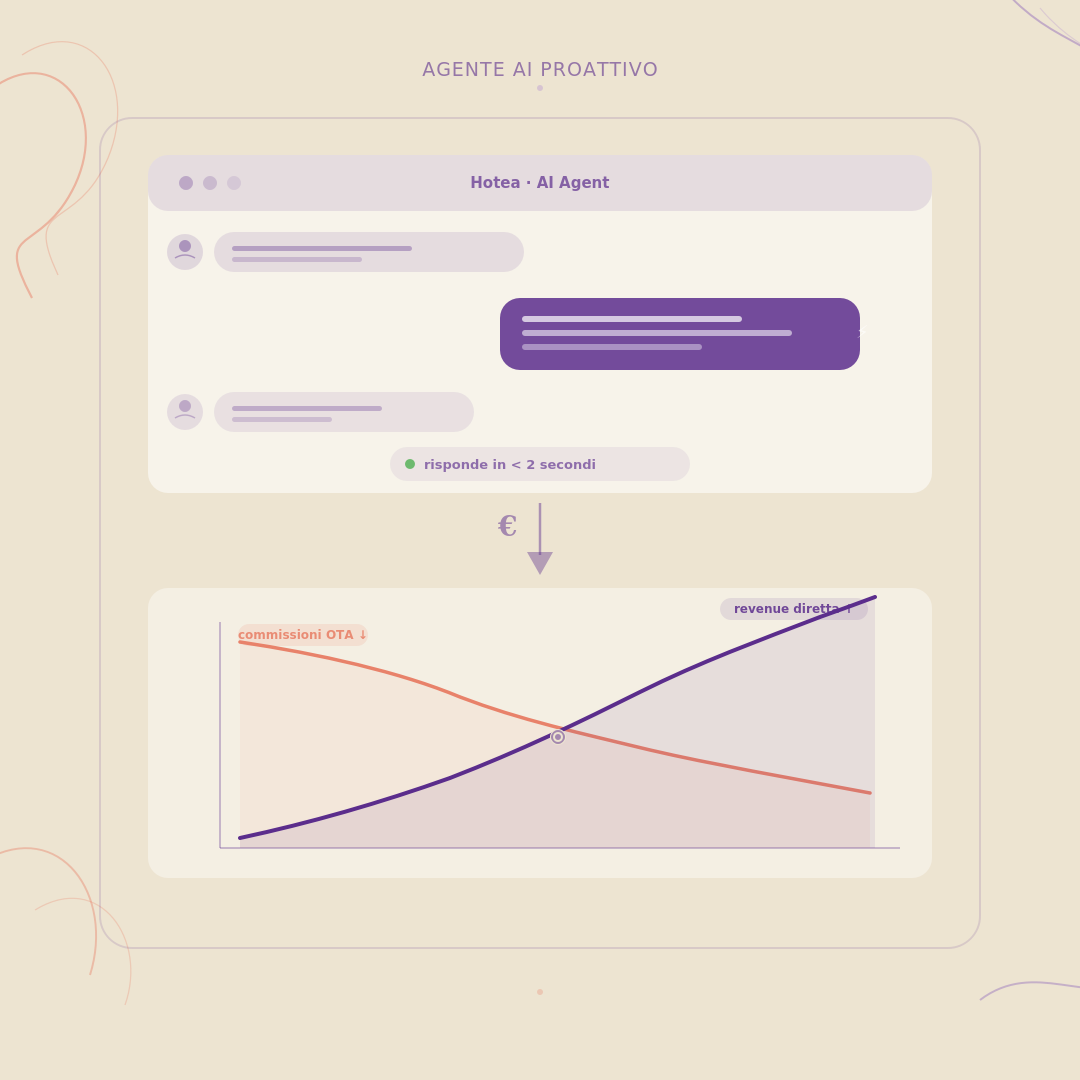
Proactive AI Agent: The Always-On Salesperson That Drives Direct Bookings
There is a precise moment when a potential guest stops browsing and decides where to book.
It lasts a few minutes. Sometimes less.
In that moment, if your property isn't present — with a fast response, a clear offer, a frictionless path to booking — the guest leaves. Usually to Booking.com. And you pay a commission.
This happens dozens of times a day, at every hospitality property. Not because the offer is wrong. Not because the price is off-market. But because no one was there, in that moment, to guide the guest toward a direct booking.
A proactive AI agent changes this dynamic in a structural way.
What "Proactive" Means in This Context
A reactive AI agent responds when prompted. It waits for a question, then answers.
A proactive AI agent does something different: it anticipates the moment of hesitation, steps in before the guest abandons the page, presents the right offer at the right time, and guides the user through the entire journey — from the first question to booking confirmation.
It's not a chatbot. It's not an automated FAQ system. It's closer to an expert salesperson who knows the product inside and out, never gets tired, responds in seconds, and never drops a lead.
How many direct bookings have you lost simply because no one responded in time?
The Real Problem: The Conversion Window Is Extremely Short
Studies on travel e-commerce consistently show that a user who waits more than a few minutes for a response is highly likely to leave the site and look elsewhere. That usually means an OTA — where the property pays commissions that can reach 15–25% per booking.
This means every booking "lost" due to slow response has a double cost:
- the foregone direct revenue,
- the commission paid when the guest books anyway — but through an intermediary.
A direct booking AI agent eliminates this bottleneck entirely. It responds at all times — at night, on weekends, during the group check-in that has the entire staff occupied.
How It Works in Practice: From First Contact to Confirmed Booking
The typical journey of a proactive AI agent for hotels unfolds through concrete steps.
1. The user lands on the site (or writes on WhatsApp)
The agent is already there. It doesn't wait for the user to click "contact us": based on the user's behavior — pages visited, time on site, sections consulted — it can proactively initiate a helpful conversation.
2. It understands requests in natural language
The guest writes the way they'd text a friend: "Do you have rooms available in July for two adults and a child?" or "How much is the sea-view suite?" The agent interprets the message, responds precisely, and immediately presents availability and rates.
3. It responds in seconds and personalizes based on profile
No generic answers. It knows that family likely needs a late check-out, that couple wants to know about the spa, that business traveler needs an invoice. It adapts accordingly.
4. It guides toward direct booking, without friction
Instead of saying "click here for the booking engine" and hoping for the best, the agent builds the path: it shows the offer, highlights the advantages of booking direct (better price, breakfast included, flexible cancellation), and accompanies the guest all the way to confirmation.
5. It hands off to the human operator when needed
If the request is complex, the guest is undecided, or negotiation is required, the agent transfers the conversation to staff — with full context already in place. No repetition, no waiting.
The Economic Advantage: Less OTA Dependency, More Direct Revenue
The math is straightforward.
A direct booking pays no commission. An OTA booking pays an average of 15–25%. On a €150/night room, for a week-long stay, that's €157–262 in commission for a single booking.
Now multiply that by the bookings that "escape" the direct channel every month.
A direct booking AI agent doesn't replace OTA portals — which remain valuable for visibility — but it reduces dependence on them for bookings that could already have been captured directly.
The goal isn't to eliminate Booking.com from the mix. It's to stop paying commissions on guests who were already on your website.
Direct Booking Advantages: What the AI Agent Communicates Effectively
Many properties offer better terms for guests who book direct, but fail to communicate them effectively. The AI agent becomes the perfect vehicle for this message — at the exact moment when the guest is still deciding:
- Best price guaranteed compared to OTA portals
- Greater cancellation flexibility
- Included extras (breakfast, parking, upgrade)
- Direct contact with staff for special requests
- Loyalty program or return-guest benefits
This isn't a list to bury in a static page. It's an argument the agent delivers at the right moment — in the conversation, while the guest is still making up their mind.
Why a Proactive Agent Converts Better Than a Traditional Live Chat
Traditional live chats have a structural problem: they require human availability. When staff is busy (or unavailable), the chat becomes a contact form with a delayed response. And the golden conversion window has already closed.
A proactive AI agent doesn't have this problem:
- available 24 hours a day, 7 days a week
- responds in 2–3 seconds, not 2–3 hours
- doesn't get tired, doesn't strike the wrong tone, doesn't forget to follow up
- handles dozens of simultaneous conversations without quality loss
- learns from context and improves precision over time
And when a conversation genuinely requires a human, staff steps in with all context already available — no starting over from scratch.
The Role of Context: Why "Proactive" Doesn't Mean "Intrusive"
There is a fundamental difference between useful proactivity and annoying sales pressure.
A well-configured AI agent reads the signals: a user browsing room pages is in evaluation mode. One who has visited the pricing page twice needs a concrete nudge. One who started a conversation and then went quiet may have hit a doubt.
In each of these cases, the proactive message is different. Not a generic pop-up. A contextual, timely, non-intrusive prompt.
This is the line that separates a quality AI agent from just another next-generation chatbot.
Extra Revenue: Not Just Bookings, But Integrated Upselling
A proactive AI agent doesn't stop at the booking. Once the guest has confirmed their stay, it becomes the ideal channel for offering extras naturally and contextually:
- room upgrade (before arrival, when availability exists)
- breakfast or half-board
- late check-out or early check-in
- airport transfer
- local experiences, spa, wine tastings
All of this delivered at the right moment — not in a mass email that ends up in spam, but in a conversation the guest is already reading.
This transforms the agent from a "conversion tool" into a full-funnel revenue engine: from the first website visit to the end of the stay.
Frequently Asked Questions
Can a proactive AI agent really replace the hotel's sales team? It doesn't replace human relationships when they matter, but it autonomously handles the entire phase of first contact, lead qualification, and guidance toward booking — which currently consumes a significant share of staff time.
How do you prevent the agent from giving incorrect information on availability and pricing? The agent integrates with the property's PMS and booking engine, reading availability and rates in real time. The information it provides is always up to date.
Does it work on WhatsApp too, and not just on the website? Yes. A well-designed AI agent operates across all channels where guests prefer to communicate: website, WhatsApp, email, social media. The channel changes; the quality of the response stays the same.
How long does it take to see results? Properties adopting a proactive AI agent typically see an increase in direct conversions within the first few weeks, with a more pronounced impact on response time reduction and volume management.
Conclusion
The hospitality market has changed. Guests expect immediate responses, personalized experiences, and frictionless booking journeys. OTAs built their competitive advantage on exactly this: fast responses, simple processes, zero waiting.
A proactive AI agent brings those same standards to your property's direct channel.
It's not a tool for appearing more innovative. It's a concrete commercial lever that:
- captures leads at the moment they're ready to convert,
- guides guests toward direct booking in a matter of seconds,
- reduces OTA dependency and the associated commission costs,
- generates extra revenue through contextual, timely upselling,
- frees staff from repetitive requests so they can focus on the true value of hospitality.
In a market where every booking counts and every commission percentage weighs on margins, having a salesperson that's always active, always precise, always available isn't a luxury. It's a strategic choice.
Want to discover how Hotea can become your proactive AI agent, increase your property's direct bookings, and reduce OTA dependency?