Background
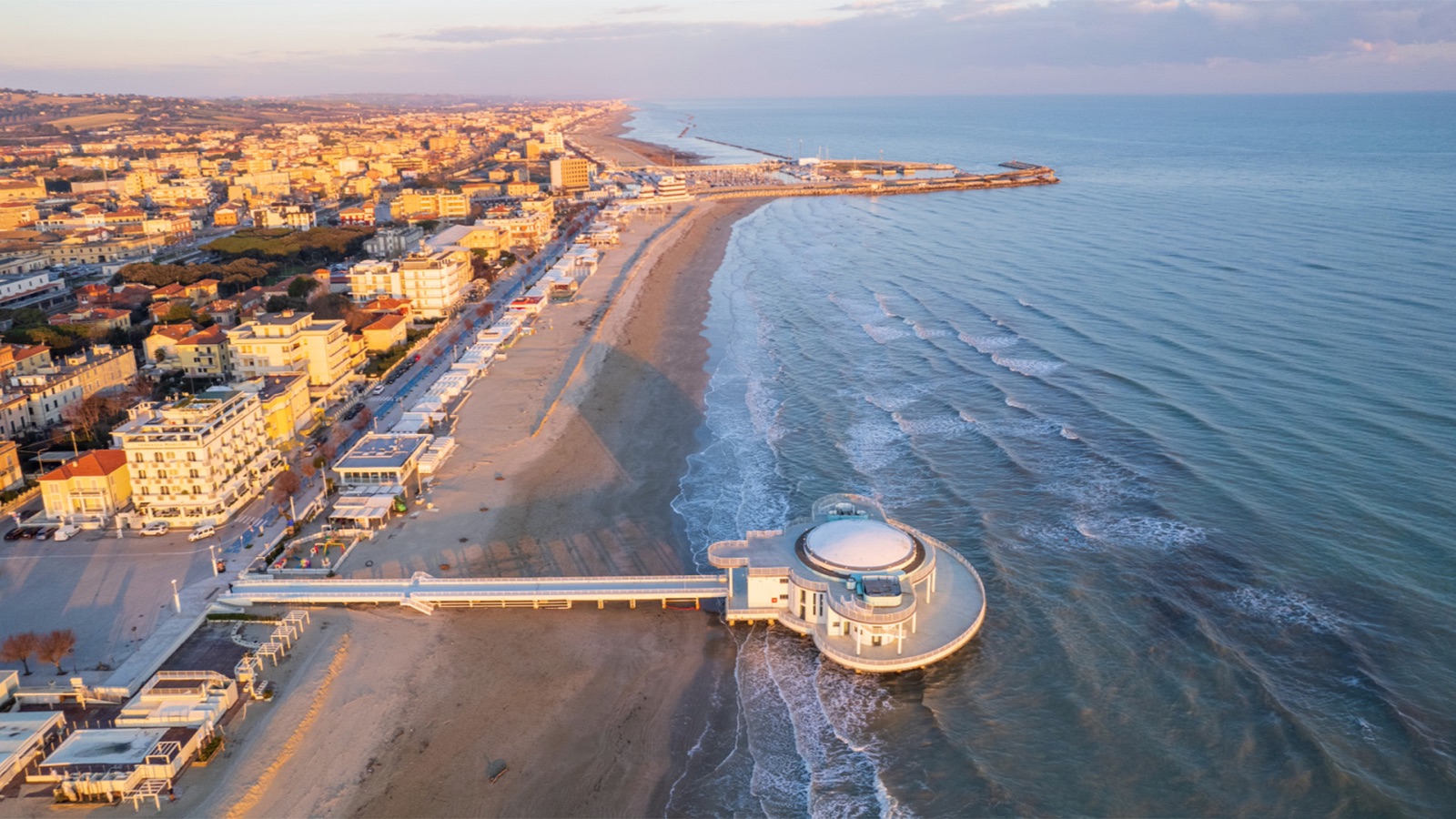
PianoB is a seaside hotel in Senigallia, on the Marche coast. Like every seasonal property, it packs almost all of its work into a few months: at the exact moment the hotel is full of guests to serve, the peak of enquiries from people still deciding whether to book arrives too.
The figures in this case study start from early May 2026 and are current as of August 18, 2026. It is a snapshot with the season still running, not a year-end report: some metrics, in particular the share of revenue attributable to cross-sell alone, are still maturing and we will update them.
The problem
In a seasonal property the bottleneck is not a shortage of enquiries, it is the time to answer them. Two dynamics in particular erode revenue.
The first: the hand-written quote. Every availability request means stopping, checking, composing a message with rooms and rates. Multiplied by hundreds of requests over a season, it becomes a cost line that appears on no shift rota.
The second: out-of-hours requests, in other languages. They arrive at night or early in the morning, when nobody is at the desk ready to answer. In a normal season they sit there until the next morning: by the time the guest reads the reply, they have often already written to someone else.
The requests that turn into quotes
The first module to go live was Hotea AI Assistant on the property's conversation channels. From early May through August 18 it has handled 2,080 guest chats and produced 376 quotes directly in chat.
These are not generic contacts: they are guests asking about availability for August, room types, breakfast, whether they can bring the children, and getting an answer and a quote without anyone at the front desk having to stop and write it.
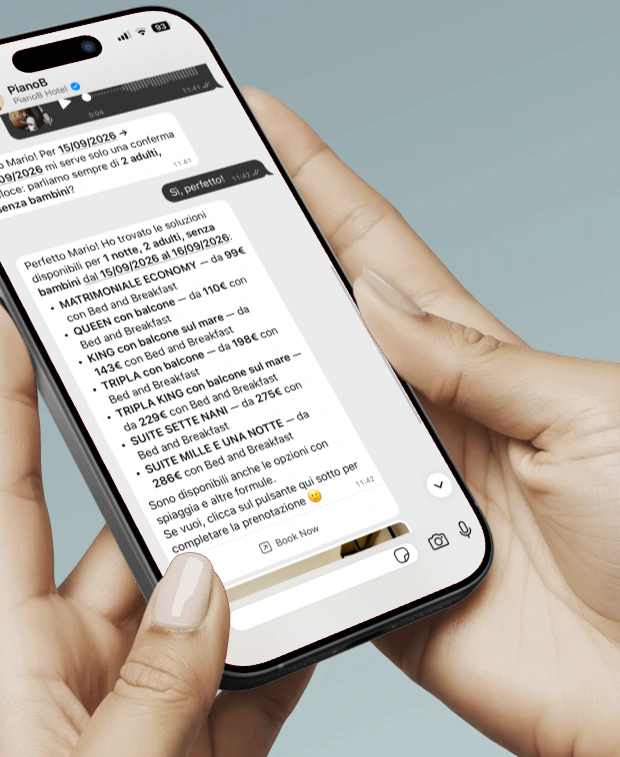
The quote contains what a guest needs in order to decide: confirmed dates, number of adults, the room types actually available (economy double, queen with balcony, king with sea-view balcony, triples, suites), each with its from-price and board formula, plus the button to complete the booking.
Run the numbers and roughly one chat in five closed with a quote (376 out of 2,080). Between quotes and other handled requests, the PianoB team took 409 hours of manual work off its plate since the season opened, about 51 eight-hour working days.
The revenue generated directly in chat
Beyond chats and quotes, what matters for the property is the revenue that comes in without the front desk having to step in.
Between bookings completed entirely in chat (from the first question to payment) and accepted cross-sell offers, PianoB now generates over €1,000 a week. It is not an isolated number: it is the weekly value range we keep seeing on other properties running Plutonios, with some generating even more.
There is also a channel insight worth noting: 73% of chats come from the website widget, the remaining 27% from WhatsApp. At PianoB, the website, not WhatsApp, is now the main contact point with the assistant: useful context for anyone treating cross-sell or guest win-back campaigns as a "WhatsApp-only" thing.
Cross-sell and automations that generate revenue
Then there is the part that goes beyond answering. At PianoB the cross-sell feature, currently in Beta, is already live and configured.
Before check-in, a service offer built for that guest goes out automatically on WhatsApp, using the property's own priced services: late checkout, beach, lunch or dinner at the restaurant. Each offer gets its own card and its own booking button.
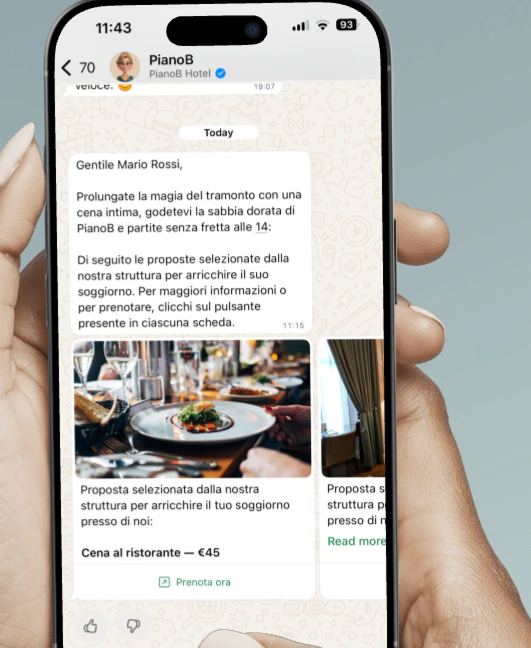
This is the piece that turns a conversation into additional revenue on the same room, with no extra load on the staff.
What separates it from a mass send happens upstream: Plutonios does not push generic offer messages, it starts from segmentation and profiling built with proprietary algorithms. It identifies guest type, interests, preferences and sentiment, and composes an offer written for that guest. The same feature can drive targeted WhatsApp campaigns to win back past guests and build loyalty.
We are not putting a number on cross-sell's own share of that revenue yet: the feature is in Beta and we are still isolating its contribution precisely from direct bookings. We will update this once the figure is solid.
Why it holds together
The reason this is not a pile of disconnected features is that every guest has their history centralised in one place. Whoever replies always picks up where the last person left off, the guest never has to repeat themselves, and handover between the people covering the chats is clean.
On a front desk rotating shifts in peak season, that is the difference between a guest who is followed and a guest who starts over every time.
What we take away
Five things that transfer to any seasonal property.
The quote is the bottleneck, not the reply. Saying "yes, we have availability" costs little; composing rooms, rates and formulas costs time. That is where automation frees real hours: 409 since the season opened at PianoB.
Night hours are revenue, not courtesy. In a market where a guest writes to three properties at once, the first to reply starts ahead. An AI covering all 24 hours does not improve service: it moves conversion.
Cross-sell works when it is profiled. An offer built on the guest's profile and sent at the right moment is a different thing from a price list sent to everyone.
The channel that matters most is not always the obvious one. At PianoB 73% of chats come from the website widget, not WhatsApp. Before investing in a channel on assumption, it is worth looking at your own property's data.
This is not a one-off number. Over €1,000 a week between direct bookings and upsell generated in chat is the value range we keep seeing across other properties running Plutonios, not a PianoB fluke.
To see how this applies to your property, start with the digital concierge and the WhatsApp chatbot for hotels.